
TL;DR
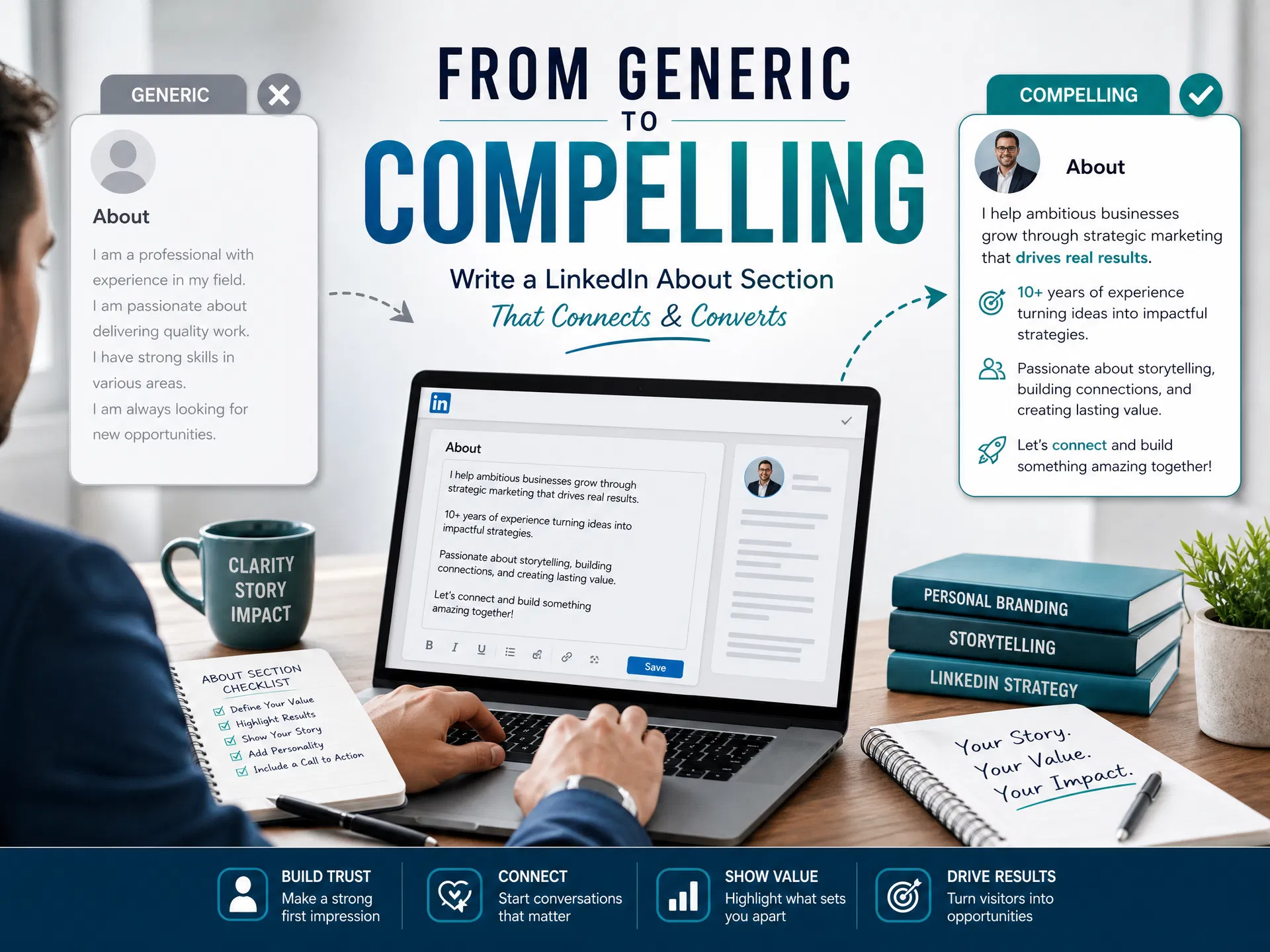
Your LinkedIn About section is not a resume summary. It's a sales page.
Most professionals treat it like a formal bio—listing job titles, responsibilities, and credentials in a way that puts readers to sleep. They wonder why their profile gets views but no meaningful engagement, no connection requests from the right people, no inbound opportunities.
The reason is almost always the same: their About section failed to answer the one question every visitor is asking within the first three seconds: Should I care about this person?
This guide walks you through exactly how to write a LinkedIn About section that converts profile views into real business conversations.
Why Your LinkedIn About Section Matters More Than Your Headline
Your headline gets attention. Your About section builds trust.
LinkedIn's algorithm shows your headline to people searching for your skills or industry. It's your first impression—critical, but brief. Your About section, however, is where serious prospects spend time. It's where they decide whether you're worth connecting with, worth messaging, worth remembering.
According to LinkedIn's own data, profiles with a complete, compelling About section receive significantly more profile views, connection requests, and inbound messages than profiles with generic or missing About sections. In fact, profiles with a strong narrative in the About section are 40 times more likely to receive inbound opportunities than incomplete profiles.
But here's what most professionals get wrong: they treat the About section like a formal document to be written once and forgotten. They don't realize it's the single highest-leverage piece of copywriting on their entire profile.
The 5-Part Framework for a Converting LinkedIn About Section
Every About section that converts follows the same underlying structure. Master this framework and you can write an About section that turns passive viewers into engaged prospects.
Part 1: The Hook (First 1-2 Sentences)
Your hook has one job: make the reader want to keep reading.
Most About sections start with "I am..." or "I have..." or "With over X years of experience..." These openings are forgettable. They describe credentials, not value.
A converting hook does something different. It:
Weak hook: "I am a personal branding coach with 7 years of experience helping professionals build their LinkedIn presence."
Strong hook: "Most professionals are invisible on LinkedIn—not because they lack expertise, but because they haven't learned to communicate it strategically."
The strong hook works because it immediately identifies a problem the reader recognizes. It makes them think, "Yes, that's me," which compels them to keep reading.
Part 2: The Problem (2-3 Sentences)
After you've hooked them, articulate the specific problem your ideal audience faces.
This is where you demonstrate that you understand their world. You're not talking about yourself yet; you're talking about them. This builds rapport and signals that you're worth listening to.
Example: "In a competitive market, having a complete LinkedIn profile isn't enough. You need a profile that communicates your unique value within three seconds, attracts the right connections, and converts profile views into real business opportunities. Without a strategic approach, even talented professionals remain invisible to the people who could benefit most from their expertise."
Notice: this section doesn't mention the writer's credentials. It's entirely focused on the reader's pain point. This is intentional and powerful.
Part 3: Your Credibility (2-3 Sentences)
Now you've earned the right to talk about yourself.
This is where you establish why you're qualified to help solve the problem you just described. But here's the key: lead with specific outcomes, not just titles or experience.
Weak credibility: "I have a background in marketing and have worked with several companies on their branding strategies."
Strong credibility: "As founder of Personal Brand Lab, I've helped over 500 professionals across Singapore, Asia, and beyond transform their LinkedIn presence into a consistent source of inbound leads. My clients include teams at Samsung, Prudential, L'Oréal, and Diageo, as well as hundreds of consultants, entrepreneurs, and executives who've gone from invisible to inbound."
The strong version works because it:
Part 4: Proof (2-4 Sentences)
Credibility claims are good. Proof is better.
This is where you provide concrete evidence that you deliver on your promises. This might be:
Example: "In my work with these clients, the pattern is consistent: after 3-6 months of strategic personal branding, most report measurable increases in inbound enquiries, shorter sales cycles, and the ability to command premium pricing. Speaking engagements, media features, and partnership opportunities they never had to pitch for begin arriving organically."
This section builds trust by showing, not just telling.
Part 5: The Call to Action (1-2 Sentences)
End with a clear, specific next step.
Most About sections end with vague language like "Let's connect!" or "Feel free to reach out." These are weak CTAs because they don't tell the reader what to do or why.
A strong CTA is specific, easy to understand, and aligned with your business model.
Weak CTA: "I'd love to hear from you. Let's connect!"
Strong CTA: "If you're ready to transform your LinkedIn presence and attract inbound leads, book a free 20-minute strategy call via [WhatsApp](https://api.whatsapp.com/send/?phone=6589053430) or visit [personalbrandlab.co](https://personalbrandlab.co) for a free LinkedIn audit. Explore [testimonials](/testimonials) from clients who have achieved remarkable results."
The strong CTA works because it:
How to Write Your Own Converting About Section: Step-by-Step
Step 1: Write your hook. Spend time on this. It's the difference between someone reading your About section and someone scrolling past.
Step 2: Identify the specific problem your ideal client or audience faces. Write 2-3 sentences from their perspective, not yours.
Step 3: List your top 3-5 credibility markers. What specific outcomes have you delivered? What recognizable clients have you worked with? What credentials or recognition do you have?
Step 4: Translate those credibility markers into proof. Don't just list them; show how they translate into results for your clients.
Step 5: Write a clear, specific CTA. What do you want the reader to do next? Make it easy.
Step 6: Edit ruthlessly. Remove jargon, clichés, and anything that doesn't directly support your message.
Common LinkedIn About Section Mistakes to Avoid
Mistake 1: Starting with "I am" or "I have"
These openings are passive and forgettable. Start with an observation, a question, or a bold statement instead.
Mistake 2: Making it all about you
Your About section should spend more time talking about your audience's problem than about your credentials. Readers care about themselves first.
Mistake 3: Using corporate jargon
Phrases like "synergistic solutions," "thought leadership," and "paradigm shift" are red flags. Write like you speak.
Mistake 4: Forgetting the CTA
An About section without a clear next step is a missed opportunity. Tell the reader exactly what to do.
Mistake 5: Making it too long
LinkedIn's About section allows up to 2,600 characters. Most readers will skim the first 150-200 characters. Lead with your strongest material.
Frequently Asked Questions
How long should my LinkedIn About section be?
While LinkedIn allows up to 2,600 characters, most readers will skim the first 150-200 characters before deciding whether to keep reading. Write your hook and problem statement to capture attention immediately, then expand with credibility and proof for readers who are genuinely interested.
Should I use first person or third person in my About section?
Use first person. It's more personal, more authentic, and more likely to build connection. Third person comes across as formal and distant.
How often should I update my About section?
Review and update your About section whenever you achieve a significant milestone, complete a major project, or gain new credentials. At minimum, review it quarterly to ensure it remains current and relevant.
Can I include links in my About section?
Yes. LinkedIn allows you to include links in your About section. Use them strategically to direct readers to your website, booking calendar, or specific resources.
What if I'm not sure what my unique value proposition is?
This is the most common blocker. Start by asking: What problem do I solve? Who specifically do I solve it for? What outcome do they get? Answer these three questions clearly, and your About section will write itself.
Share this article